|
 Centre for Addiction Centre for Addictionand Mental Health Please note: This is the very old CAMH website from 2012, made available for legacy purposes. |
|
|
|
About Mental Health & Addictions
|
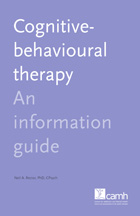
What is cognitive-behavioural therapy?From: Cognitive-behavioural therapy: An Information Guide (© 2010 CAMH) For much of the 20th century, the dominant form of psychotherapy was psychoanalysis. This approach involved seeing a therapist several times a week, often for years. Then, in the 1970s, an explosion of different approaches to psychotherapy began to appear. Many of these were short term, lasting only weeks or months. In 1979, Time magazine reported that there were almost 200 different types of psychotherapy. As of 2010, there are thought to be between 400 and 500 types. However, when directly compared, only a handful of therapy approaches have been shown to be highly effective for the kinds of problems people usually seek help for, such as depression, anxiety, phobias and stress-related problems. Of the many therapies available, cognitive-behavioural therapy (CBT) is increasingly identified as the “gold standard”—that is, the best type of therapy for these difficulties. This conclusion is supported by more than 375 clinical trial studies since 1977 and also by current international treatment guidelines, which are based on the collective knowledge of experts in the field. For instance, the National Institute of Mental Health (NIMH) in the United States and the National Institute for Health and Clinical Excellence (nice) in the United Kingdom have concluded that among the available psychological treatments for anxiety and depression, CBT is recommended as the first-line psychological treatment. CBT has been shown to be effective for people of all ages, from early childhood to older adults, and for people of different levels of education and income and various cultural backgrounds. It has also been shown to be effective when used in individual or group formats. Introducing CBTCBT is an intensive, short-term (six to 20 sessions), problem-oriented approach. It was designed to be quick, practical and goal-oriented and to provide people with long-term skills to keep them healthy. The focus of CBT is on the here-and-now—on the problems that come up in a person’s day-to-day life. CBT helps people to look at how they interpret and evaluate what is happening around them and the effects these perceptions have on their emotional experience. Childhood experiences and events, while not the focus of CBT, may also be reviewed. This review can help people to understand and address emotional upset that emerged early in life, and to learn how these experiences may influence current responses to events. According to CBT, the way people feel is linked to the way they think about a situation and not simply to the nature of the situation itself. This idea is rooted in ancient Eastern and Western philosophies and became part of a mainstream psychotherapy approach in the early 1960s. Aaron T. Beck, the father of CBT, described the negative thinking patterns associated with depression (i.e., critical thoughts about oneself, the world and the future) in his early writings. He also outlined ways to target and reduce negative thoughts as a way to improve mood. In later work, Beck and his colleagues focused on the content and processes of thought related to anxiety and ways to treat anxiety problems. Since its creation, CBT has expanded into one of the most widely used therapeutic approaches. What happens in CBT?In CBT, you learn to identify, question and change the thoughts, attitudes, beliefs and assumptions related to your problematic emotional and behavioural reactions to certain kinds of situations. By monitoring and recording your thoughts during situations that lead to emotional upset, you learn that the way you think can contribute to emotional problems such as depression and anxiety. In CBT, you learn to reduce these emotional problems by:
For CBT to be effective, you must be open and willing to discuss your thoughts, beliefs and behaviours and to participate in exercises during sessions. For best results, you must also be willing to do homework between sessions. What conditions can CBT treat?CBT is an effective treatment for many psychological conditions. These include:
CBT can also be used to help people with:
A similar framework is used to treat different emotional problems in CBT; however, the approach and strategies vary and are tailored to address each specific problem. Why is CBT an effective therapy?CBT is an effective therapeutic approach because it:
In describing how CBT works, the focus of this guide will be on how it applies to treating people experiencing emotional distress. |
 Related Links |


|
Last updated: Nov 26, 2010 3:18 PM Published: Oct 25, 2012 6:13 PM ID#P53927 |