|
 Centre for Addiction Centre for Addictionand Mental Health Please note: This is the very old CAMH website from 2012, made available for legacy purposes. |
|
|
|
About CAMH
|
Strategic Planning at CAMH - Frequently Asked Questions
Why is strategic planning important? We see it as part of our organizational value of Continuous Learning. From time to time it’s essential to take a step back, evaluate our work and ask some foundational questions:
A good strategic plan encompasses not only the essential ‘DNA’ of an organization like CAMH (mission, vision and values), it also outlines our broad strategic directions and the goals we’re setting in pursuit of them. It also sets out how we’re measuring ourselves to know if we’re successful. Planning, setting goals and measuring them are some of the most basic ways we can be accountable to the people we serve. They’re the hallmarks of excellence. These elements will be fundamental drivers of CAMH’s new five-year strategic plan, which will take effect in May, 2012.
How is this strategic plan process different from past ones? CAMH’s current Strategic Plan 2009-2012 was a ‘refresh’ of the prior plan -- a fine-tuning of the basic goals and directions we already had in place. Now, with our first decade behind us and mental health and addictions issues at the forefront of public consciousness, it’s a logical time for a more robust, from-the-ground up review and evaluation of the ‘foundational questions’ mentioned above. What’s more, the current healthcare environment is a complex and demanding one. Along with the challenges, there are also greater opportunities than ever to serve more people affected by mental illness and addiction.
Can I weigh in on CAMH’s future planning? Yes! We welcome feedback at any time. Please email us with your thoughts, reactions and ideas, or call us at (416) 535-8501 ext. 6631. Also, watch CAMH’s website and Facebook page for future opportunities for consultation and engagement on strategic planning.
How are you organizing your strategic planning process? 1. Environmental Scan and public consultation - CAMH conducted an extensive environmental scan (see Related Links on the right side of this page) and public consultations as part of the 2009-2012 strategic Plan process, and we believe the information in those reports remains valid today. In addition, we made use of other important scans and reports on mental health and addictions issues that have been done since that time. Just a few of these include:
2. Values exercise Values are the ‘DNA’ of organizational culture, and CAMH has been lauded in the past for the level of awareness and engagement our staff has with our own values. Accordingly, one of the first elements of this process is an engagement initiative with staff and other stakeholders around CAMH’s values. 3. Key Themes As a hospital, CAMH focuses on the patients in our care today. And as an academic health sciences centre we are responsible for securing the health of tomorrow’s patients. On this basis, and from our environmental scanning and ongoing interaction with peer hospitals, the community and other partners, we refined our key themes. These serve as the essential platforms for a consistent planning process. Today - Keeping our promises for the people we serve. Review and Alignment: Much of our organizational structure, especially in clinical service delivery, remains as it has since CAMH’s inception in 1998. It’s time to review how we’re organized and how we work to ensure that CAMH is best calibrated to serve clients, families, and the public as a 21st century academic health sciences centre. One of CAMH’s four special strategic planning task forces has undertaken this work and will make recommendations by late 2011. This group combines some of our staff and leadership with external experts, leaders and members of the community. Health Equity: A commitment to issues of diversity and health equity has always been one of CAMH’s hallmarks. Now we’re seeing these issues become increasingly prevalent across the healthcare sector, most notably with the passage of the Excellent Care for All Act. We believe there remains much work to be done in this area, and CAMH will continue working to ensure that health equity informs all of our work in care, discovery and sharing. We will continue to focus on work with marginalized communities, elder care, and the forensic mental health system. Our second task force will bring a health equity lens to building a CAMH strategy for children and youth mental health and addictions services. This is timely in two ways: First, CAMH’s Child, Youth & Family Program is evolving. Next year we will open Canada’s first full-service inpatient program for youth with concurrent disorders (that is, someone contending with both mental illness and addiction) as part of the current phase of our Queen Street Redevelopment. Second, the Province of Ontario announced a special focus on children and youth as the first part of its Comprehensive Mental Health and Addictions Strategy. Tomorrow - Getting better to serve and to lead. Enhancing Discovery: CAMH has made significant strides in advancing knowledge and understanding of mental illness and addiction. Building on our multidisciplinary approach to research is one of the key ways for us to meet the demands of the 21st century. CAMH will continue working to embed the link between patient care and science, and in sharing our expertise, throughout our organizational culture. Our third strategic planning task force will focus on identifying the most vital research questions related to mental illness and addictions and help us map a strategy for addressing them. Create Capacity: CAMH will play the leading and collaborative role that’s expected of us to advance mental health and addictions issues within our society. We will continue our work throughout the system, across the province and beyond. We will continue to focus on building problem-solving partnerships, community engagement, advocacy and on education, training and knowledge exchange. A key area of community engagement will be enhancing our strategic partnership with the CAMH Foundation. Accordingly our fourth strategic planning task force is focusing on awareness and impression of CAMH – the branding and reputation of the organization that will be foundational to our ability to create capacity in the many ways described above.
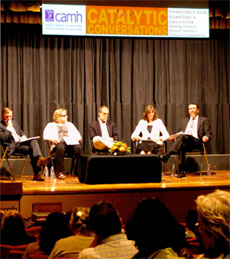
What are these ‘Catalytic Conversations’ that you’re organizing? Sometimes it’s healthy to kick-start debate and bring special awareness to certain topics. Our ambition is to stimulate new thinking and ideas around key areas of interest, to aid in our strategic planning. A good example is our June 23, 2011 Catalytic Conversation entitled “Someone’s Son, Someone’s Daughter,” focusing on the many complex questions around forensic mental health and addictions, and services for people who come in contact with the criminal justice system. Though CAMH’s Law & Mental Health Program, we are one of many parts of the forensics system, and we believed it was time to help facilitate a discussion, with other groups who part of the system, to move the conversation to a clinical one rather than merely a legal one. We also held a Catalytic Conversation as part of our June 16, 2011 Annual General Meeting focused on Children and Youth Mental Health and Addictions. Watch a video recording of this event on our CAMHTV channel on YouTube. Watch CAMH’s website and Facebook page for updates on future Catalytic Conversations planned for 2011 and 2012. |
 Related Links |



|
Last updated: Jul 25, 2011 1:21 PM Published: Jun 10, 2019 4:13 AM ID#P59121 |