|
 Centre for Addiction Centre for Addictionand Mental Health Please note: This is the very old CAMH website from 2012, made available for legacy purposes. |
|
|
|
About Mental Health & Addictions
|
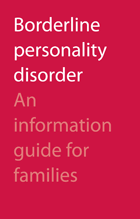
Recovery and HopeFrom: Borderline personality disorder: An information guide for families. (© 2009 CAMH) I am learning to deal with loss and grief and accept my daughter for who she is. I am not expecting a perfect ending but I do
have more hope for the future and I know I am not alone. Research has shown that people can recover from BPD and that their recovery is often long-lasting. Everyone’s path to recovery is different, whether you are the individual with BPD or a family member or friend. Recovery involves the development of new meaning and purpose in life as people grow beyond the impact of BPD. We think O’Grady and Skinner (2007) say it best: “Recovery has also been described as a process by which people recover their self-esteem, dreams, self-worth, empowerment, pride, dignity and meaning.” Both the individual with BPD and their family members will go through this process of recovery. As a family member, you can instill hope that changes can be achieved by providing support to your loved one as you all go through the long journey of recovery. It is important to understand though that recovery is not a straight path. There will be deviations along the way that can involve relapse into old behaviours, and the person may or may not return to their previous level of functioning. On the path to recovery, your family member may need medication or further contact with the treatment system. For people to achieve and maintain recovery from BPD, they need to:
More information on recovery is available in A Family Guide to Concurrent Disorders, listed on p. 44. |
 Related Links |


|
Last updated: Apr 27, 2011 3:52 PM Published: Oct 10, 2012 6:19 PM ID#P48201 |